
XRDS-RF UHF Arrestor
4.6Editor score
PL-259 female to female
Low insertion loss under 0.4dB
Nickel plated brass body
This guide compares ten top-rated Ham Radio Lightning Protection for Antennas units to help you safeguard your equipment from voltage spikes and storm damage
Protecting your ham radio equipment from lightning strikes is crucial for safety and longevity. A good arrester diverts dangerous voltage spikes to ground before they reach sensitive gear.
We evaluated ten highly rated models based on build quality, insertion loss, frequency range, and grounding options. This list covers UHF, N-Type, and bulkhead styles for various setups.
Each pick shows key specs, pros, cons, and real user feedback to guide your decision. Please note that product prices and availability may change over time on the retailer site.
4.6Editor score

4.8Editor score

4.8Editor score
This side-by-side comparison highlights key differences across all ten selected models. Check the specs to find the right connector type and protection level for your station.




This XRDS-RF model stands out as a top value pick with a strong 4.6 rating. It offers reliable protection for ham and CB radios with minimal signal loss.
We may earn a commission when you buy through this link, at no additional cost to you.
Its brass nickel plated body ensures durability while the internal Teflon insulator maintains signal integrity. The low insertion loss of under 0.4dB is impressive for this price range.
The only trade-off is that you must provide your own ground cable. Also, its frequency range tops out at 500MHz which may not suit higher band setups.
Buy this if you need dependable entry-level protection for VHF or lower systems. It balances cost and quality better than most competitors in its class.
The design minimizes signal attenuation ensuring your transmission remains clear even during storm season.
Nickel electroplating on brass resists corrosion for years of outdoor use on towers or vehicles.
We may earn a commission when you buy through this link, at no additional cost to you.
The Diamond SP1000 is engineered for serious protection across mobile and base stations. It earns high marks for its ability to handle 6000 Amps of surge energy.
We may earn a commission when you buy through this link, at no additional cost to you.
Its replaceable surge element means you can reset protection after a strike without replacing the whole unit. The wideband capability covers most amateur bands effectively.
While it costs more than basic arrestors the longevity and performance justify the investment. Ensure you connect it to a proper ground path for best results.
Choose this for multi-band stations needing robust defense against severe weather. It is a trusted name among operators for critical protection needs.
Unlike sealed units this model allows maintenance after a surge event to extend overall service life.
With six thousand amps discharge capacity it handles severe lightning induced surges better than standard units.
We may earn a commission when you buy through this link, at no additional cost to you.
The Workman A28 is a straightforward option for those needing basic surge diversion. It features a convenient ground screw on the side for quick setup.
We may earn a commission when you buy through this link, at no additional cost to you.
Its PL259 male and female ends make it easy to insert into existing coax runs without adapters. The price point makes it accessible for many operators.
Expect simpler construction compared to premium models. It serves well for occasional storm protection but lacks advanced features like replaceable elements.
Buy this for simple CB or base antenna setups on a tight budget. It provides essential safety without unnecessary complexity or cost.
The side screw terminal simplifies connecting a ground wire directly to the arrester body.
Standard PL259 connectors ensure compatibility with most coax cables and antennas.
We may earn a commission when you buy through this link, at no additional cost to you.
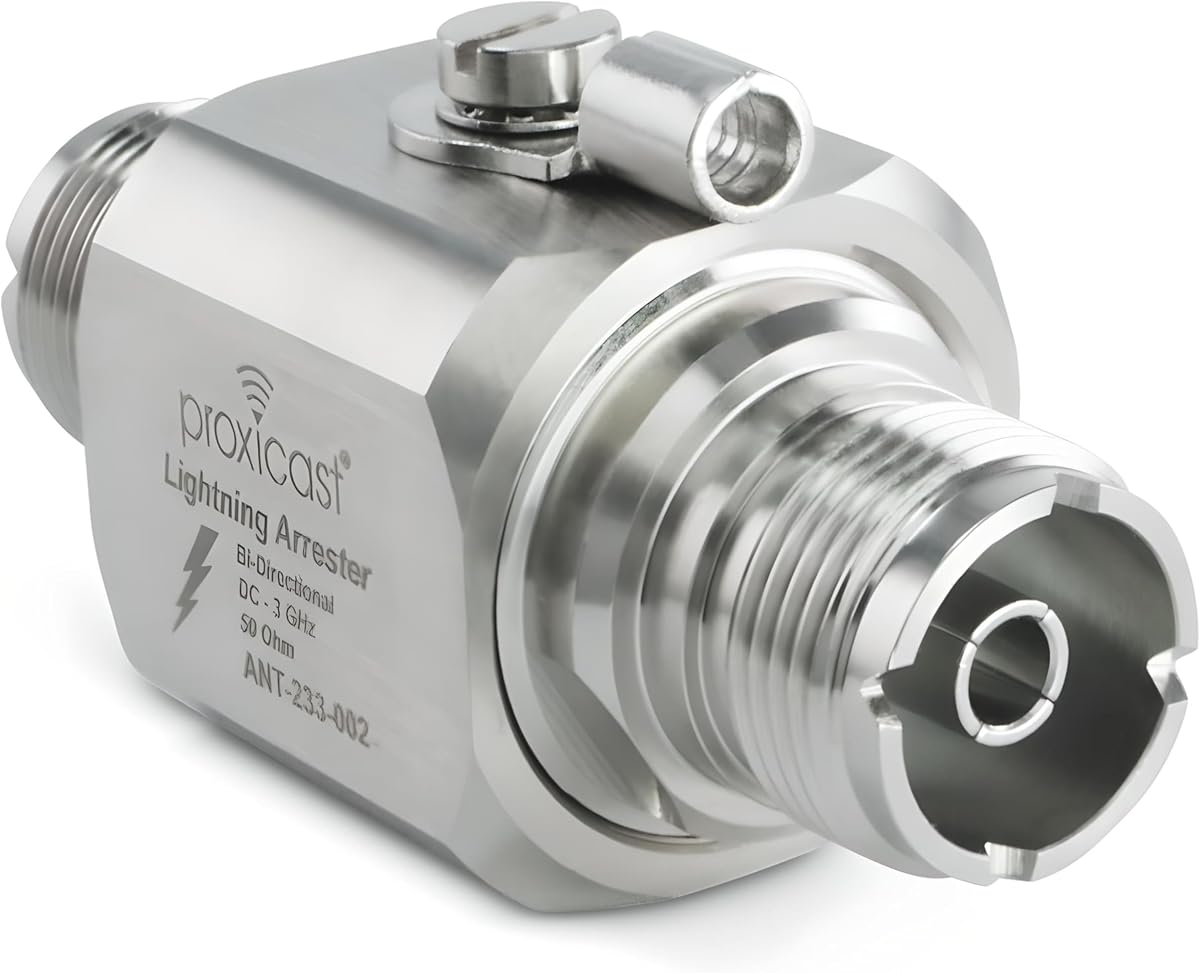
The Proxicast ProGrade uses a 230V gas discharge tube for effective surge shunting. It is ideal for setups using SO239 connectors on base stations.
We may earn a commission when you buy through this link, at no additional cost to you.
Bi-directional protection ensures safety from both antenna and ground-side transients. The DC pass-through feature allows DC power to pass through for remote antenna units.
While the SO239 connectors may require adapters for some users the performance is solid. It offers good insulation resistance for long term reliability.
Choose this for base stations using SO239 lines needing DC pass-through. It balances professional features with reasonable pricing for serious operators.
Allows DC bias to pass through to antennas without needing a separate injection point.
230V gas tubes quickly clamp voltage spikes to protect sensitive receiver front ends.
We may earn a commission when you buy through this link, at no additional cost to you.
This generic UHF model boasts a perfect five star rating for reliable performance. It comes with an earth lead included for convenient grounding.
We may earn a commission when you buy through this link, at no additional cost to you.
The aluminum housing aids heat dissipation and resists corrosion well in outdoor environments. Its internal components do not require fuse replacements after use.
While brand recognition is lower user feedback suggests it works as well as bigger names. It is a great choice for those wanting included grounding accessories.
Pick this for VHF or two-way setups where simplicity and included accessories matter. It delivers solid protection without needing extra purchases.
Having a ground wire in the box saves time and ensures proper grounding from the start.
Aluminum construction helps manage internal heat generated during surge events effectively.
We may earn a commission when you buy through this link, at no additional cost to you.
The Diamond SP3000 is a premium choice for stations using N-Type connectors. It offers robust protection up to 3000MHz covering all major bands.
We may earn a commission when you buy through this link, at no additional cost to you.
With a 200W power rating and 1000A impulse handling it stands up to heavy usage and strong storms. The N-Type connectors ensure secure high quality connections.
It is more expensive than UHF units but justified for serious HF or UHF work. Ensure your cables use N-Type to match this unit.
Buy this for high performance stations prioritizing reliability and connector quality. It represents top tier protection for demanding amateur operators.
N-Type connectors offer better performance at higher frequencies than standard UHF types.
Two hundred watt capacity suits high power transmitters without risking unit failure.
We may earn a commission when you buy through this link, at no additional cost to you.
This bulkhead style arrestor fits neatly through copper strips or enclosure walls. It uses PL259 male to SO239 female to bridge connector types.
We may earn a commission when you buy through this link, at no additional cost to you.
The integrated nut allows secure mounting in boxes where external cables enter. The 230V gas tube provides standard protection against surges.
Power handling is limited to 50W so it is best for low power setups or receive only systems. It works well inside enclosures needing a feed through.
Choose this for panel mounting in shielded enclosures or low power stations. It simplifies cable entry while adding a layer of surge safety.
Designed to be mounted flush in a panel preventing external exposure to elements.
Allows connection between different coax connector types in a single device.
We may earn a commission when you buy through this link, at no additional cost to you.
This two pack offers excellent value if you have multiple antennas to protect. Both units feature brass nickel plating for durable outdoor performance.
We may earn a commission when you buy through this link, at no additional cost to you.
They use standard UHF female connectors which fit most coax setups easily. The gas discharge tubes divert surge energy safely to ground wires.
Having two units allows protection for both receive and transmit paths if needed. It simplifies buying multiple arrestors for a complete setup.
Buy this for stations with multiple antennas needing coordinated protection. It saves time and money compared to buying singles separately.
Protecting both transmit and receive cables reduces risk of damage across your whole system.
Nickel plating on brass extends life in humid or coastal environments significantly.
We may earn a commission when you buy through this link, at no additional cost to you.
The RAIGEN arrestor covers zero to six GHz making it suitable for WiFi IoT and Ham. It offers a universal solution for mixed technology setups.
We may earn a commission when you buy through this link, at no additional cost to you.
A 90V gas tube with replaceable capability ensures long term use. The included ground lug simplifies safe bonding to building ground systems.
Its low insertion loss keeps signals strong even at high frequencies. Weatherproof construction ensures it survives harsh outdoor conditions indefinitely.
Choose this for IoT or cell booster setups alongside ham radio. It handles modern broadband needs better than older narrowband units.
Covers everything from CB up to 5GHz WiFi in a single unit for versatility.
Pre-installed lug makes grounding connection easier and more reliable than using screws alone.
We may earn a commission when you buy through this link, at no additional cost to you.
The Opek LP-350a is designed for high wattage CB and ham applications. It handles up to 350 watts making it safe for strong transmitters.
We may earn a commission when you buy through this link, at no additional cost to you.
With a ground terminal and PL259 connectors installation is straightforward. Its 50 Ohm impedance matches most amateur equipment perfectly.
Frequency range is limited to 600MHz so it is best for VHF or lower. It focuses on power handling rather than ultra wide frequency coverage.
Buy this for CB or VHF stations needing extra power handling. It provides solid protection for higher power setups on a budget.
Three hundred and fifty watt rating protects equipment during high power transmissions.
50 Ohm design ensures minimal reflection and optimal signal transfer across the line.
We may earn a commission when you buy through this link, at no additional cost to you.
Selecting the right protector requires considering connector types, frequency ranges, and power handling. This guide breaks down the key factors.
Match the arrester connector to your existing coax cable to avoid extra adapters. Common types include PL259 UHF and N-Type. Mismatched connectors can introduce signal loss or connection issues.
Always verify the plug and socket style on both ends before buying to ensure a direct fit.
Ensure the unit covers all bands you use. Some units stop at 500MHz which is fine for CB or VHF but not UHF or microwave. Wider range gives more versatility.
Check the DC to MHz rating to confirm it supports your highest operating frequency without attenuation.
Low insertion loss is vital to maintain signal strength. Look for units under 0.5dB to keep your transmission clear. High loss can degrade performance noticeably.
Select models explicitly listing low dB insertion loss for best signal integrity.
Higher amp ratings like 6000A provide better surge diversion capability. This ensures the unit handles stronger lightning induced surges safely. Lower ratings might fail under severe stress.
Prioritize specs showing high impulse discharge values for critical station protection.
A proper ground connection is mandatory for protection to work. Some units include ground lugs or screws while others need separate cables. Easy grounding features simplify installation.
Ensure the unit offers a reliable terminal for attaching a ground wire directly.
Outdoor use requires durable materials like brass or aluminum. Nickel plating helps resist corrosion. Weatherproof units last longer in harsh environments.
Choose models described as outdoor rated for long term reliability.
Higher wattage capacity ensures the unit can handle your transmitter output without damage. 50W units work for low power while 200W+ suit high power setups.
Check the wattage rating to match your radio transmit power.
Units with replaceable gas tubes allow resetting after a surge. This extends the life of the protector compared to sealed ones. It saves money over time.
Look for replaceable surge elements for better long term value.
Install the arrester as close to the entry point as possible to ground the coax before it enters your shack. This minimizes the path for surges to reach gear.
Secure a proper ground cable to the arrester terminal and connect it to a ground rod or building ground system. A short and thick wire works best for effective drainage.
Inspect the unit annually for corrosion or loose connectors. Ensure the ground wire remains intact and free from damage to maintain protection during storms.
Yes. Most arrestors require a separate ground cable to divert surge energy safely to earth. Without grounding the unit cannot effectively protect your equipment from voltage spikes.
Arrester are designed for induced surges and nearby strikes not direct hits. A direct strike can overwhelm most units so physical distance and tower grounding are also vital for safety.
Yes. Even receive-only systems can suffer from static or nearby strikes. Protecting sensitive receivers prevents damage to front end components that are easily destroyed by surges.
Gas tubes may degrade after severe surges. Check manufacturer guidelines. Some units allow visual inspection or have replaceable elements. If you suspect a strike occurred check or replace the unit.
Yes high insertion loss can slightly reduce effective radiated power. Choose units with low dB loss to minimize this impact. Good quality arrestors keep loss under 0.5dB for minimal effect.
Yes provided the arrester covers the frequency range. Units like RAIGEN support up to 6GHz which works for WiFi and IoT. Check frequency specs to ensure your bands are supported.
The Diamond Antenna SP3000 XRDS-RF UHF Arrestor and RAIGEN N-Type Arrestor lead the pack for performance versatility and reliability across different station types.
Prioritize matching connector types and frequency ranges to your setup to avoid unnecessary adapters. Proper grounding is just as important as the arrester itself for effective protection.
Always check current product prices and availability on the retailer site since these can change over time. Select the model that best fits your budget and station requirements.