
ESP8266 ESP-01S
4.4Editor score
4MB Flash Memory
Stronger Signal
Compatible with Arduino
This guide compares the top ten Arduino WiFi modules for IoT projects, covering connectivity, performance, and ease of use for makers and professionals alike.
Connecting your Arduino projects to the internet opens up a world of possibilities for IoT and automation. A reliable WiFi module is essential for sending data, receiving commands, and controlling devices remotely. Choosing the right one depends on your specific needs and project requirements.
We have evaluated ten top-rated modules based on connectivity options, processing power, and community support. Our analysis includes both dedicated add-on modules and integrated boards designed for seamless wireless communication. Each product offers unique strengths for different development scenarios.
Each review highlights key features, pros, and cons to help you make an informed decision. Prices may fluctuate due to market conditions and availability. Always check the latest details before purchasing to ensure you get the best value for your investment.
4.4Editor score

4.7Editor score

4.7Editor score
This section provides a side-by-side comparison of all ten modules to help you quickly identify the best fit for your project needs.



The Arduino UNO R4 WiFi represents a significant leap forward in the classic Arduino ecosystem. Combining a Renesas RA4M1 microcontroller with an ESP32-S3 wireless chip, it offers dual-core processing that handles complex tasks while maintaining seamless connectivity. With a rating of 4.7, users praise its versatility for advanced IoT applications.
We may earn a commission when you buy through this link, at no additional cost to you.
Its standout feature is the combination of processing power and integrated wireless capabilities. The board supports Wi-Fi and Bluetooth 5.0, enabling robust communication without external modules. The included 12×8 LED matrix provides immediate visual feedback, while the USB-C port simplifies power delivery and programming. Additional features like 12-bit DAC and CAN support make it suitable for industrial and automotive projects.
While the performance is impressive, the complexity may be daunting for absolute beginners. The dual-core architecture requires understanding how tasks are distributed. However, the added functionality justifies the learning curve for serious developers. The price is higher than basic modules, but the onboard features often eliminate the need for add-ons.
This board is ideal for developers working on sophisticated IoT systems requiring both computing power and wireless connectivity. Whether you are building smart home hubs or industrial sensors, the UNO R4 WiFi delivers reliability and speed. We recommend it for projects that demand more than standard microcontroller capabilities.
The combination of the RA4M1 and ESP32-S3 allows you to run main application logic on one core while managing wireless communication on the other without interference.
The onboard LED matrix lets you display data or status indicators directly on the board, reducing the need for external screens in prototyping phases.
We may earn a commission when you buy through this link, at no additional cost to you.
The HiLetgo ESP8266 ESP-01 modules offer a straightforward way to add wireless capabilities to your Arduino projects. Each pack includes three units, providing value for bulk prototyping. With a rating of 4.2, these modules are recognized for their basic functionality and ease of use in simple IoT setups.
We may earn a commission when you buy through this link, at no additional cost to you.
These modules support three distinct modes: AP, STA, and AP+STA, allowing flexibility in how they connect to networks. The onboard processing capabilities of the ESP8266 handle lightweight data transmission effectively. They are compatible with Arduino IDE, making it easy to write sketches that communicate via serial interfaces.
However, the ESP-01 lacks onboard voltage regulators, requiring a stable 3.3V power source. This can complicate wiring for beginners who might accidentally connect it to 5V logic. Additionally, the memory is limited compared to newer chips. Despite these drawbacks, the low cost makes it accessible for students and hobbyists.
Ideal for basic sensor monitoring or simple remote control applications, these modules are a cost-effective solution. If you are building multiple prototypes, the 3-pack ensures you have spares. It is a solid starting point for learning wireless communication fundamentals.
You can configure the module to act as a standalone access point or connect to an existing router, offering versatility for different network topologies.
Using the serial interface simplifies data exchange between the module and your main microcontroller, reducing wiring complexity.
We may earn a commission when you buy through this link, at no additional cost to you.
The ESP8266 ESP-01S improves upon the original with additional flash memory and a stronger antenna design. It is priced affordably, making it a top choice for budget-conscious builders. Users rate it 4.4, appreciating the enhanced performance over older variants.
We may earn a commission when you buy through this link, at no additional cost to you.
With 4MB of flash, you have more room for storing data and sketches, which is crucial for applications logging information. The signal strength is optimized for better connectivity in slightly larger spaces. Documentation and community support are extensive, simplifying the setup process for new users.
Care must be taken with power supply as it operates strictly on 3.3V. Overvolting can damage the unit instantly. The pins are also delicate, requiring gentle handling during soldering or insertion into breadboards. Despite these minor handling issues, the performance per dollar is excellent.
This module is perfect for projects needing moderate storage and reliable WiFi without breaking the bank. Whether you are logging sensor data or controlling lights, it delivers consistent performance. It remains a staple for hobbyist electronics due to its affordability.
The 4MB flash allows you to store more code and data locally, enabling more complex logic without constant external storage.
Upgrades to the antenna design provide better range and stability, reducing connection drops in moderately sized rooms.
We may earn a commission when you buy through this link, at no additional cost to you.
Aitrip offers a five-pack of ESP8266 ESP-01 modules, ideal for classrooms or teams building multiple units. The modules function reliably within a voltage range of 3.0V to 3.6V. With a rating of 4.4, they are trusted for general-purpose IoT tasks.
We may earn a commission when you buy through this link, at no additional cost to you.
These modules support standard AP, STA modes and work with AT commands for easy configuration. They are compatible with Arduino, NodeMCU, and other platforms, providing flexibility in development. The price per unit is very competitive, making it easy to experiment without financial risk.
You must ensure your power supply is stable at 3.3V. The lack of onboard regulation means you need external components for safety. However, the durability is sufficient for repeated use in prototyping phases. It is a practical choice for projects needing redundant wireless nodes.
Suitable for smart grids and transportation projects, these modules are designed for scalable deployment. If you are teaching WiFi concepts or need spares for production, this pack is ideal. It simplifies sourcing and ensures consistency across all your devices.
Buying five units at once reduces the cost per module significantly, making large-scale projects more affordable.
Compatible with NodeMCU and Arduino, these modules fit into various ecosystems, allowing you to choose your preferred framework.
We may earn a commission when you buy through this link, at no additional cost to you.
The ELEGOO ESP-32 Dev Board combines high-performance computing with integrated wireless features. It features a dual-core processor running at 240 MHz, ensuring fast data processing. Rated 4.7, it is favored for demanding applications needing both speed and connectivity.
We may earn a commission when you buy through this link, at no additional cost to you.
Unlike single-core modules, the dual-core architecture allows you to run background tasks without interrupting the main logic. The built-in Bluetooth 4.2 expands options beyond WiFi, enabling communication with mobile devices. Power-saving modes extend battery life in portable projects.
OTA update support means you can modify firmware wirelessly, which is crucial for deployed systems. You need a USB-C cable for initial setup, which may not be included in the box. Despite this, the convenience of modern interfaces outweighs the minor inconvenience.
This board is perfect for automation, sensors, and connected devices requiring reliable performance. Whether you are managing home appliances or industrial monitors, it delivers efficiency. It is a premium choice for projects where uptime and speed are critical.
Running Wi-Fi on one core and logic on the other ensures stable connections even during heavy processing tasks.
OTA updates let you fix bugs or add features remotely, keeping your projects up to date without physical access.
We may earn a commission when you buy through this link, at no additional cost to you.
The Arduino Nano ESP32 brings the power of the ESP32-S3 to a compact form factor. Without headers, it offers a cleaner footprint for production boards. Users rate it 4.5 for its balance of size and performance in embedded applications.
We may earn a commission when you buy through this link, at no additional cost to you.
It supports MicroPython, allowing developers to code in Python for rapid prototyping. The USB-C port ensures better power delivery and faster data transfer. HID support enables you to create custom keyboards or mice, opening creative possibilities for human-machine interaction.
While powerful, the lack of headers means you must solder or use a carrier board immediately. This adds a step to the workflow but improves reliability. The cost is higher than third-party boards, but the official support ensures quality.
Ideal for wearable devices and smart sensors, this board is built for innovation. If you prefer Python for coding, it offers an intuitive environment. It is a great choice for developers wanting modern tools in a small package.
MicroPython compatibility makes coding accessible and allows for interactive testing directly on the device.
HID profiles allow the board to act as input devices, useful for custom controllers and interactive interfaces.
We may earn a commission when you buy through this link, at no additional cost to you.
This pack of four ESP8266 ESP-01S modules is useful for testing different configurations. Each module undergoes self-calibration to ensure optimal RF performance. With a 4.4 rating, it is trusted for wearable electronics and home automation.
We may earn a commission when you buy through this link, at no additional cost to you.
The RF calibration process minimizes signal issues, providing consistent connectivity. These modules are built to be reused multiple times, reducing waste. They fit well into sensor networks where small size and low power are priorities.
Documentation is minimal, which might challenge those new to the hardware. However, the standard design means online resources are abundant. The packaging is basic, focusing on the product rather than extras. It is a functional choice for practical work.
For sensor networks and location sensing, these modules provide the necessary connectivity. If you are assembling multiple sensors, this pack offers value. It is recommended for users who prioritize performance over packaging.
Self-calibrated RF ensures that each module performs reliably, reducing signal dropouts in your network.
Built to be reused, these modules are cost-effective for iterative development and testing phases.
We may earn a commission when you buy through this link, at no additional cost to you.
This pack offers five modules with 4MB flash, improving storage over standard versions. Rated 4.5, users appreciate the extra memory for complex tasks. It is designed for Arduino and IoT applications requiring reliable data logging.
We may earn a commission when you buy through this link, at no additional cost to you.
The DOUT protocol allows for better performance during programming and operation. It operates strictly on 3.3V, so attention to voltage is critical. The 5-pack is ideal for projects needing multiple nodes or for sharing with team members.
Be aware of the voltage sensitivity to avoid damaging components. The documentation links provided help guide setup and programming. Overall, the balance of price and memory capacity is strong for the current market.
Perfect for smart home devices needing local storage, these modules handle data efficiently. If you are building multiple sensors, this pack ensures consistency. It is a solid choice for hobbyists looking for value.
4MB flash allows storing more data locally, which is useful for logging without continuous internet connectivity.
Five units give you flexibility to build multiple projects without needing to reorder supplies.
We may earn a commission when you buy through this link, at no additional cost to you.
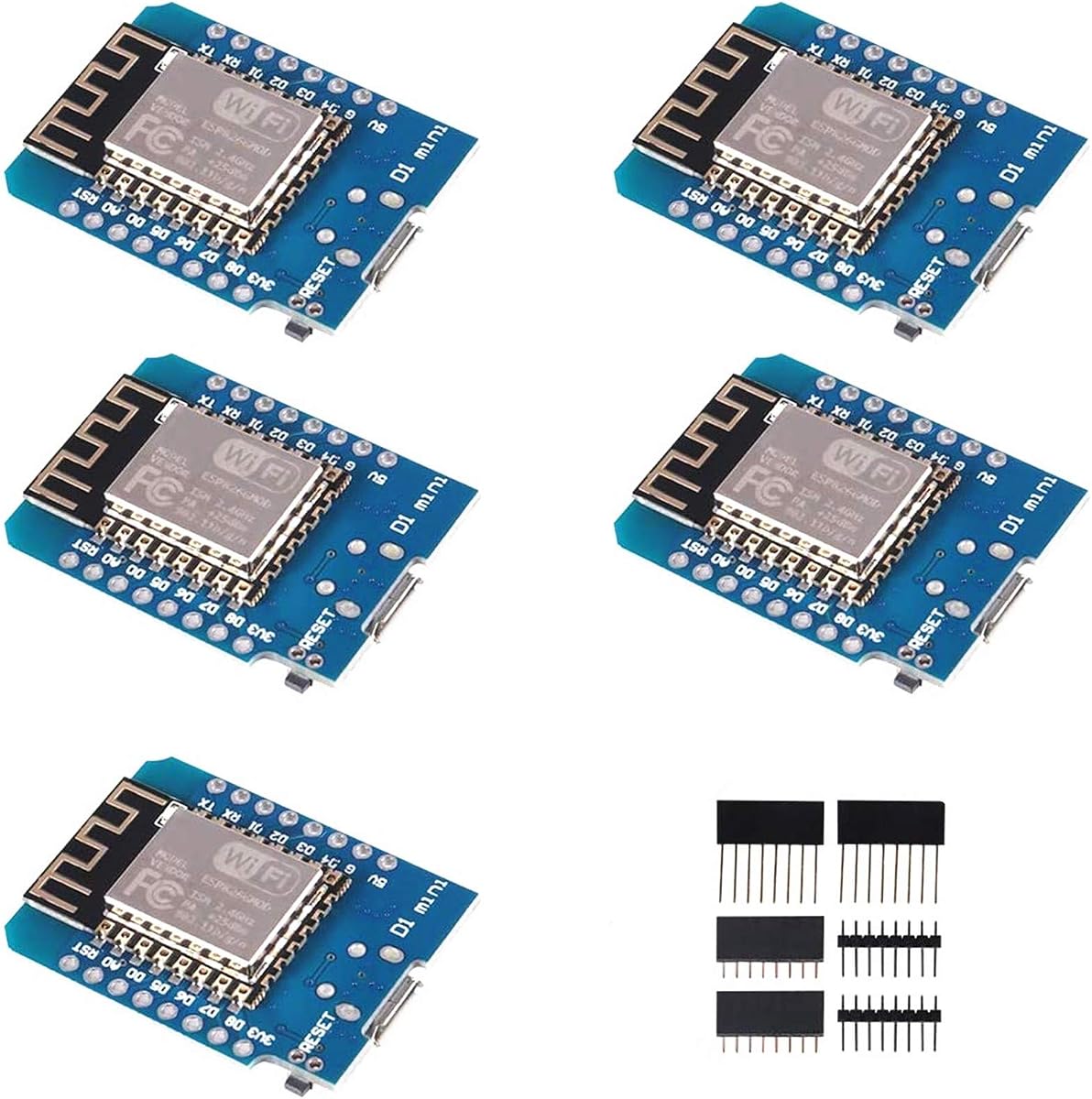
The ESP-12F mini module combines WiFi with many GPIO pins for flexibility. Rated 4.5, it is popular for projects needing many inputs. It features an onboard switching power supply, simplifying power management.
We may earn a commission when you buy through this link, at no additional cost to you.
It supports Lua and Arduino IDE, offering development flexibility. With Micro USB, connecting to a computer is straightforward. The compact size allows fitting into tight spaces, making it ideal for portable devices.
You may need to solder headers for prototyping, which adds a step. The small form factor requires care when handling to avoid bending pins. Despite this, its versatility makes it a favorite for custom boards.
Best for complex setups needing many sensors, this module handles multiple connections efficiently. If you are building interactive devices, the extra pins are useful. It is a practical choice for makers wanting connectivity and I/O options.
Eleven digital pins let you connect multiple sensors and actuators without additional expanders.
Integrated switching power supply ensures stable voltage, reducing the need for external regulators.
We may earn a commission when you buy through this link, at no additional cost to you.
This 10-pack offers the highest quantity in the lineup, rated 5.0 for reliability. It is ideal for production runs or large experiments. The modules feature robust processing capabilities for efficient task execution.
We may earn a commission when you buy through this link, at no additional cost to you.
Supporting AP, STA, and AP+STA modes provides versatility for networking. LWIP support streamlines compatibility with Arduino platforms. With ten units, you can build extensive networks or have plenty of spares for testing.
The modules are basic but effective, focusing on core connectivity features. They take up less space than full development boards. The value per unit is excellent for those needing volume.
Perfect for large-scale IoT deployments, these modules allow scalability. If you are prototyping a product line, this pack ensures consistency. It is a smart choice for efficiency and budget management.
Ten units provide enough quantity for initial production batches without requiring multiple orders.
Multiple modes allow the modules to function in various network setups, adapting to different project needs.
We may earn a commission when you buy through this link, at no additional cost to you.
Selecting the right module depends on your project requirements, budget, and technical expertise. Consider these factors carefully.
WiFi modules vary in the protocols they support. Some offer only WiFi, while others include Bluetooth for hybrid connectivity. Ensure the module supports the specific protocol your project requires.
Choose modules with the necessary standards to avoid compatibility issues.
The processor speed and cores determine how quickly tasks are handled. Dual-core modules manage data processing and communication better than single-core.
For complex tasks, prioritize boards with higher processing capabilities.
Flash memory storage is crucial for holding code and data logs. Modules with more flash allow for larger sketches and offline capabilities.
Select options with ample memory if you need extensive local storage.
User-friendly interfaces and support simplify development. Boards with built-in USB-C and clear documentation reduce setup time.
Look for features that streamline your workflow and reduce errors.
Battery-powered projects require low power modes to extend life. Check if the module supports sleep modes and energy-saving features.
Opt for energy-efficient models to ensure long-term operation.
Cost varies significantly between basic modules and full boards. Balance functionality with your financial limits to avoid overspending.
Choose solutions that provide value without unnecessary extras.
Active communities provide forums and guides for troubleshooting. Popular platforms often have more resources available.
Prioritize boards with strong support networks for easier problem-solving.
Connect your module to a stable power source to prevent crashes during operation. Use external regulators if needed to maintain the correct voltage levels.
Upload sketches through the IDE and test connectivity regularly to ensure reliability. Keep firmware updated to access new features and patches.
Protect modules from moisture and dust to extend their lifespan. Store unused boards in dry containers when not in use.
ESP32 offers dual-core processing, Bluetooth, and higher speed compared to ESP8266. It is better for complex projects needing more power. ESP8266 remains popular for simple, cost-effective tasks.
Connect the module to serial pins using a level shifter if required. Most boards are 3.3V, so ensure your Arduino can provide this. Use appropriate libraries for communication.
Yes, once programmed, they can operate independently on power. They connect to WiFi directly to perform tasks without needing a host.
Range depends on the environment but is typically around 100 feet indoors. Antenna upgrades can extend this to larger areas.
Ensure you use secure protocols like HTTPS for data. Strong passwords and encryption protect devices from unauthorized access.
Some boards like the Nano ESP32 support MicroPython natively. Others can use it with specific firmware flashing.
We reviewed ten options ranging from basic modules to advanced boards. The Arduino UNO R4 WiFi stands out for performance, while the ESP8266 variants offer affordability.
Prioritize connectivity needs and power requirements when selecting. Choose boards with support that matches your project scale.
Always check the latest availability and pricing before buying to ensure you get the best value for your specific needs.