This guide compares the top ten Arduino ADC boards for precision sensing, featuring detailed specs, user ratings, and key features to help you choose the right
As an Amazon Associate we earn from qualifying purchases. We may earn a commission when you buy through links on this page, at no additional cost to you. Read our affiliate disclosure.As an Amazon Associate we earn from qualifying purchases.Purchases through our links may earn us a commission, at no extra cost to you. Read our affiliate disclosure.
Arduino projects often require measuring analog signals like voltage or sensor data. An ADC board converts these signals into digital values your microcontroller can process efficiently and accurately for various applications.
We evaluated ten popular ADC modules based on resolution, channel count, interface type, and user feedback. Our goal is to help you find the most reliable board for your specific sensing or data logging needs.
Each pick highlights key specs and real-world performance notes. Prices and availability change frequently so check the current listings before ordering to ensure you get the best value for your project budget.
Top 3 Picks for Best Arduino ADC Board
Best Budget
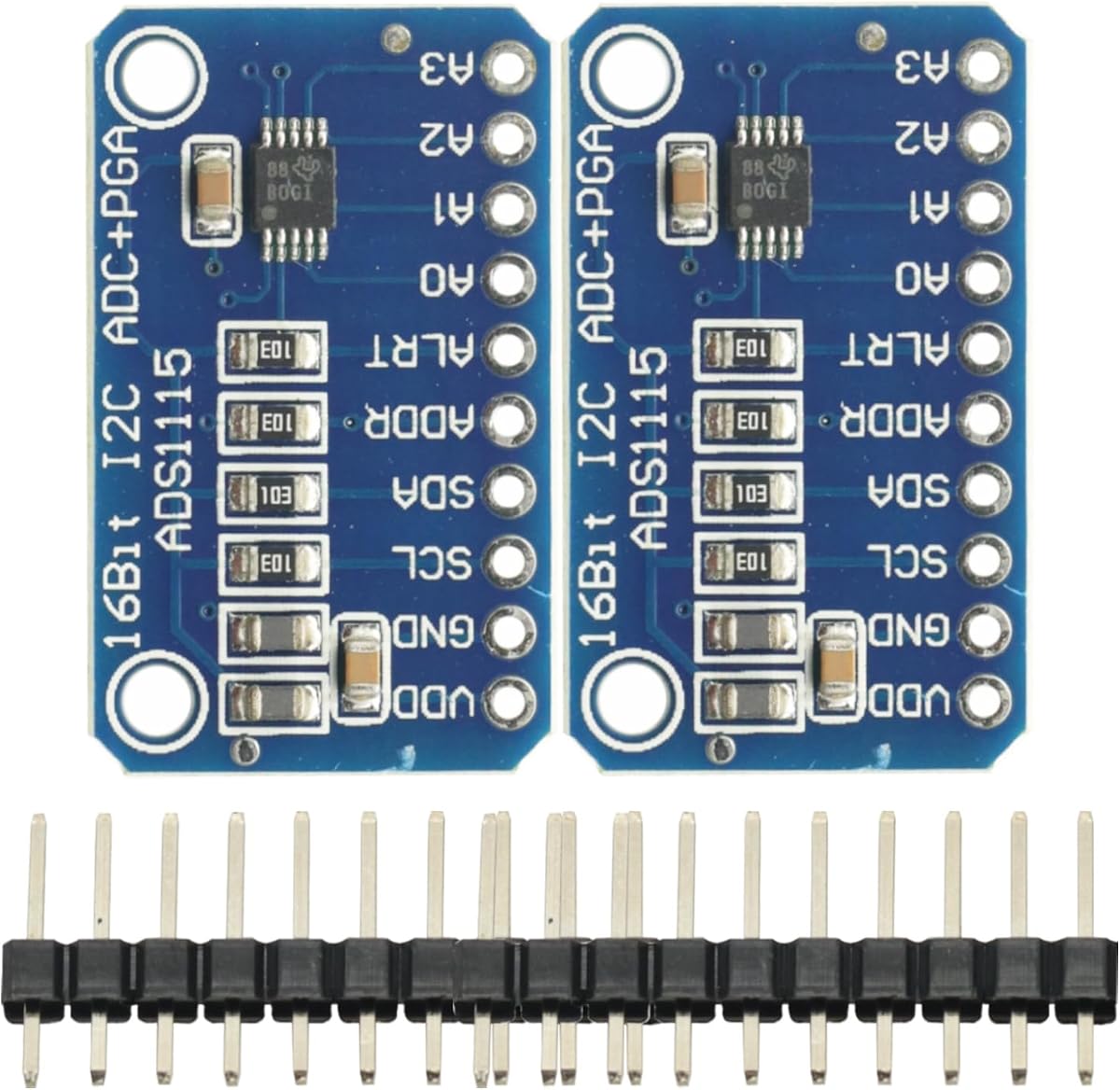
2Pcs ADS1115 16 Bit I2C Module Precision ADC 4 Channel Analog-to-Digital Converter Development Board Pro Gain Amplifier for Arduino Raspberry Pi ADC Module
The following table provides a side-by-side comparison of the top ten ADC boards. Review the specifications and features to determine which module aligns best with your project requirements and budget constraints.
ProductsSpecificationsEditor scorePrice
1
Editor's Choice
Teyleten Robot ADS1115 16 Bits 4 Channel Analog-to-Digital Converter Precised Develop Board Module Amplifier Board ADC I2C IIC for Arduino Raspberry Pi (Pack of 3pcs)
2Pcs ADS1115 16 Bit I2C Module Precision ADC 4 Channel Analog-to-Digital Converter Development Board Pro Gain Amplifier for Arduino Raspberry Pi ADC Module
HiLetgo 3pcs ADS1115 16 Bit 16 Byte 4 Channel I2C IIC Analog-to-Digital ADC PGA Converter with Programmable Gain Amplifier High Precision ADC Converter Development Board for Arduino Raspberry Pi
2PCS ADS1115 16 Bit IIC I2C Analog to Digital Converter Module Precision ADC Converter 4 Channel Development Board Programmable Gain Amplifier 2.0V to 5.5V for Arduino Raspberry Pi
HiLetgo ADS1115 16 Bit 16 Byte 4 Channel I2C IIC Analog-to-Digital ADC PGA Converter with Programmable Gain Amplifier High Precision ADC Converter Development Board for Arduino Raspberry Pi
Teyleten Robot ADS1115 16 Bits 4 Channel Analog-to-Digital Converter Precised Develop Board Module Amplifier Board ADC I2C IIC for Arduino Raspberry Pi (Pack of 3pcs)
16-Bit ADC Resolution
4 Single-Ended Inputs
I2C Communication Protocol
8 to 860 SPS
This ADS1115 module stands out as the top choice for general purpose analog to digital conversion. It delivers high precision 16-bit resolution which is essential for accurate sensor readings. The inclusion of a programmable gain amplifier allows you to measure small signals effectively.
Pros
High precision 16-bit conversion
Includes PGA for signal amplification
3-pack offers great value
Wide operating voltage range
Compatible with many microcontrollers
Cons
I2C bus speed limits sampling
Limited to low voltage inputs
We may earn a commission when you buy through this link, at no additional cost to you.
The module supports both single-ended and differential inputs giving you flexibility in how you wire your sensors. Its I2C interface makes it easy to connect to Arduino boards without using analog pins. The data rate is configurable to balance speed and noise performance.
Users should note that the 860 samples per second limit may not suffice for very high frequency signals. The input range is also limited to the supply voltage which might require buffering for larger signals. These trade-offs are acceptable for most hobbyist and industrial monitoring tasks.
Buy this if you need reliable multi-channel data acquisition for temperature pressure or voltage monitoring. The 3-pack ensures you have spares for multiple projects. It is an excellent starting point for anyone building a sensor network with an Arduino.
High Resolution Sensing
The 16-bit resolution provides 65536 discrete steps allowing for fine detection of voltage changes across your sensors.
Flexible Input Configuration
Configure channels for differential measurement to cancel noise or use single-ended mode to monitor more inputs.
HiLetgo ADS1256 5V 8 Channel 24 Bit ADC Data Acquisition Board Module High Precision AD Collecting Data Acquisition Card
24-Bit ADC Resolution
8 Input Channels
SPI Communication Protocol
On-Board Voltage Reference
The ADS1256 board is a powerhouse for applications demanding ultra high resolution. Its 24-bit ADC can resolve voltage changes down to microvolts making it ideal for strain gauges and thermocouples. The onboard voltage reference ensures stable measurements over time.
Pros
Extremely high 24-bit resolution
Eight channels for complex setups
High sampling rate of 30ksps
Stable built-in voltage reference
Low nonlinearity errors
Cons
SPI wiring is more complex
Requires specific library support
We may earn a commission when you buy through this link, at no additional cost to you.
With eight channels you can monitor many sensors simultaneously without multiplexing delays. The SPI interface allows faster data transfer than I2C which suits dynamic signal analysis. The module is designed to handle analog voltages within a specific range reliably.
Wiring can be trickier than I2C boards since SPI uses multiple signal lines. You will need a library that supports the ADS1256 chip specifically to access its full capabilities. These steps add complexity but the results justify the effort for precision work.
Choose this board for industrial sensing or scientific experiments where detail matters. The high bit depth captures subtle variations that lower bit boards miss. It is the best choice when accuracy is more important than simple setup.
Ultra High Bit Depth
24-bit resolution allows detection of extremely small voltage changes critical for precision instrumentation.
Multi Channel Monitoring
Eight independent channels simplify systems that need to track multiple sensors at once without extra hardware.
2Pcs ADS1115 16 Bit I2C Module Precision ADC 4 Channel Analog-to-Digital Converter Development Board Pro Gain Amplifier for Arduino Raspberry Pi ADC Module
16-Bit ADC Resolution
4 Input Channels
I2C Interface
Programmable Gain Amplifier
This two pack of ADS1115 modules offers incredible value for makers starting out. It provides the same core features as pricier options but at a fraction of the cost. Users report flawless performance for standard sensor integration tasks.
Pros
Excellent price for two modules
High user satisfaction ratings
Wide supply voltage compatibility
Programmable input range selection
Simple I2C wiring
Cons
No onboard voltage reference
Limited to 860 SPS
We may earn a commission when you buy through this link, at no additional cost to you.
The programmable gain amplifier lets you tweak the input range to match your sensor output. This flexibility helps optimize resolution without adding extra components. The module works well with both 3.3V and 5V logic levels.
Since it lacks an onboard voltage reference you should be aware of supply noise affecting accuracy. However for general purpose data logging this is rarely a deal breaker. The 860 SPS limit is adequate for slow changing signals like temperature.
Buy this if you need multiple ADCs for distributed sensing projects. The two pack allows you to build redundant or multi-zone systems easily. It is a smart investment for anyone wanting quality without overspending.
Cost Effective Solution
Getting two units for a low price makes it easy to scale your sensing projects without budget constraints.
Programmable Flexibility
Adjust the input range to suit different sensor types from low voltage thermistors to standard voltage dividers.
HiLetgo 3pcs ADS1115 16 Bit 16 Byte 4 Channel I2C IIC Analog-to-Digital ADC PGA Converter with Programmable Gain Amplifier High Precision ADC Converter Development Board for Arduino Raspberry Pi
16-Bit ADC Resolution
4 Input Channels
I2C Interface
Comparator Mode Support
This 3-pack of ADS1115 boards is ideal for those needing multiple nodes in a single project. The boards provide accurate conversion and can operate as comparators for simple threshold alerts. It saves wiring complexity by using I2C for communication.
Pros
Three units for a single price
Supports comparator functionality
Wide supply voltage range
Auto shutdown for power saving
Good for Raspberry Pi users
Cons
Lower user rating than others
I2C address pin setup needed
We may earn a commission when you buy through this link, at no additional cost to you.
The auto shut down feature helps conserve power in battery operated setups. You can configure the module to enter single shot mode between readings to reduce current draw. This feature extends battery life significantly in remote sensing tasks.
Some users find the I2C address pin configuration slightly confusing for beginners. Ensure you solder the jumpers correctly to avoid bus conflicts. Despite this learning curve the functionality and value provided are substantial for the cost.
Opt for this kit if you need multiple ADC boards for a distributed network. It is particularly useful for environmental monitoring across different zones. The extra units are handy for backups or future expansion.
Power Saving Features
Auto shut down modes allow the board to sleep when not actively converting data to save battery power.
Comparator Functionality
Use the built-in comparator to trigger alerts when a signal exceeds a set threshold without continuous polling.
This four pack is a fantastic choice for large scale projects requiring many analog inputs. It offers standard ADS1115 performance with an internal oscillator to ensure stable data rates. The module supports single-ended inputs which simplifies wiring for unipolar signals.
Pros
Four units for a great price
Internal oscillator for timing
Wide voltage supply range
Suitable for control applications
Supports single-ended inputs
Cons
Slightly lower user ratings
Requires careful I2C addressing
We may earn a commission when you buy through this link, at no additional cost to you.
The wide voltage supply range allows you to power it from various sources easily. It can also operate in a comparator mode which helps in maintaining accuracy for specific thresholds. These features make it versatile for control and monitoring systems.
Users need to be careful with I2C addressing when stacking multiple units on one bus. Proper configuration is needed to ensure each board responds to its unique address. This is standard practice but requires attention during setup.
Select this pack if you are building a system with many measurement points. The quantity allows you to cover a wide area without needing separate purchases. It is perfect for greenhouse monitoring or large facility checks.
Internal Oscillator
An onboard oscillator ensures consistent sampling rates without relying on external clock signals.
Wide Supply Range
Operates from 2.0V to 5.5V making it compatible with various power sources in your setup.
2PCS ADS1115 16 Bit IIC I2C Analog to Digital Converter Module Precision ADC Converter 4 Channel Development Board Programmable Gain Amplifier 2.0V to 5.5V for Arduino Raspberry Pi
16-Bit ADC Resolution
4 Input Channels
I2C Interface
2.0V to 5.5V Supply
With a perfect user rating this module is a trusted choice for reliable analog to digital conversion. It offers seven programmable input ranges which gives you fine control over the measurement window. The I2C interface keeps wiring clean and simple.
Pros
High perfect 5.0 rating
Seven programmable input ranges
Wide input voltage support
Programmable data rate option
Simple I2C integration
Cons
Limited to low frequency signals
Small form factor for soldering
We may earn a commission when you buy through this link, at no additional cost to you.
The module accepts input voltages up to the supply rail allowing direct measurement of 0 to 5V signals without divider resistors in some cases. The programmable data rate lets you optimize for speed or noise reduction based on your needs.
The small form factor can make manual soldering challenging for beginners with larger tools. It is designed for jumper wire use which might not suit all permanent installations. This is a minor constraint compared to its overall performance.
Buy this if you want a proven solution with excellent user feedback. It works well for sensor projects where precision and ease of use are key. The two pack provides flexibility for building paired sensor nodes.
Programmable Data Rate
Adjust the sampling speed to balance between quick updates and stable low noise readings.
Wide Input Support
Supports input voltages from 0 to VDD allowing direct sensor interfacing without extra scaling.
Lonely Binary 3-Pack ADS1115 16-Bit ADC I2C Module for C++ & ESP32
16-Bit ADC Resolution
4 Input Channels
I2C Interface
Gold Plated PCB
This 3-pack stands out for its high quality build with an ENIG gold plating. It is designed with C++ and ESP32 users in mind offering ready soldered headers for easy use. The brand focuses on open source compatibility which appeals to developers.
Pros
Gold plated ENIG finish
Designed for ESP32 and C++
Three pack with headers
Wide voltage compatibility
Open source friendly
Cons
Higher price than generic brands
Requires specific pin logic checks
We may earn a commission when you buy through this link, at no additional cost to you.
The module works across 3.3V and 5V logic levels without level shifters making it versatile for modern microcontrollers. The gold plating improves solderability and oxidation resistance over time. This ensures long term reliability in various environments.
The price is higher than generic equivalents but the quality justifies it for critical projects. You need to ensure your microcontroller logic levels match the module input tolerance. This compatibility check is straightforward with ESP32 boards.
Choose this if you value build quality and long term reliability. It is excellent for IoT nodes where the unit sits outdoors for months. The three pack supports scalable deployments without compromising on component quality.
Gold Plated Finish
ENIG plating resists corrosion and ensures better electrical connections for permanent soldering.
ESP32 Friendly
Optimized for ESP32 development with clear library support for C++ and MicroPython projects.
Teyleten Robot AD7606 Module Multi-Channel AD Data Acquisition Module 16-bit ADC 8-Channel Synchronization Sampling Frequency 200KHz
16-Bit ADC Resolution
8 Input Channels
SPI Interface
200KHz Sampling Rate
This module is unique for its ability to sample eight channels at 200KHz simultaneously. It is intended for high speed signal acquisition like audio or vibration analysis. The synchronized sampling ensures data points are captured at the same instant across channels.
Pros
Very high 200KHz sampling
Synchronized channel sampling
Eight channel input capacity
Internal 2.5V reference
High input impedance
Cons
Low user satisfaction rating
Complex SPI configuration needed
We may earn a commission when you buy through this link, at no additional cost to you.
It features a high input impedance of 1MΩ which reduces loading on sensitive signal sources. The internal reference provides a stable voltage for conversion. The module uses SPI for communication allowing faster data retrieval than I2C.
The low user rating suggests a steep learning curve or reliability issues. Configuration requires careful handling of control signals and timing. It may not be suitable for beginners needing a plug and play experience.
Buy this only if you specifically need high speed synchronized sampling. It is powerful for waveform capture but difficult to use correctly. Ensure you have the expertise to manage the timing requirements before ordering.
Synchronized Sampling
All channels sample at the exact same time preserving phase relationships in multi-channel signals.
High Speed Rate
200KHz sampling enables capturing fast transient signals that standard ADCs would miss.
This 4-pack offers an excellent balance of quantity and quality for general purpose projects. It delivers the standard ADS1115 performance with a built-in PGA to enhance sensitivity. The high user rating indicates consistent performance across units.
Pros
Four units for low cost
High user satisfaction rating
Internal PGA for sensitivity
Wide microcontroller compatibility
Simple I2C integration
Cons
No onboard voltage reference
I2C bus speed limits
We may earn a commission when you buy through this link, at no additional cost to you.
The module is compatible with many microcontrollers including Arduino ESP32 and STM32. Its I2C interface simplifies wiring reducing the pin count required on your main board. This makes it ideal for embedded systems with limited GPIO.
The lack of an onboard voltage reference means performance depends on your system power quality. For typical hobbyist use this is usually acceptable. Keep your power supply stable to get the best accuracy from these modules.
Select this pack if you need multiple sensors across a project. It is perfect for multi-zone environmental monitoring or distributed data logging. The four units give you plenty of coverage without extra assembly.
Built-in PGA
Internal programmable gain amplifier helps boost small signals for better resolution.
Microcontroller Compatibility
Works with a wide range of controllers making it versatile for different system architectures.
HiLetgo ADS1115 16 Bit 16 Byte 4 Channel I2C IIC Analog-to-Digital ADC PGA Converter with Programmable Gain Amplifier High Precision ADC Converter Development Board for Arduino Raspberry Pi
16-Bit ADC Resolution
4 Input Channels
I2C Interface
Comparator Mode
This module is particularly popular for Raspberry Pi users who lack analog GPIO pins. It brings precise analog conversion to the Pi using a simple I2C connection. The high precision converter ensures accurate readings for sensors.
Pros
Great for Raspberry Pi GPIO
High precision conversion
Easy I2C setup
Auto shut down mode
Wide voltage supply range
Cons
Limited to low voltage inputs
Requires header soldering
We may earn a commission when you buy through this link, at no additional cost to you.
The comparator mode helps maintain accuracy by triggering alerts on signal thresholds. Auto shut down mode reduces power consumption when idle. These features make it suitable for energy efficient monitoring setups.
Users need to solder headers before use which adds a small setup step. The input voltage is limited to the supply rail so high voltage signals need attenuation. These are minor considerations for the convenience it offers.
Buy this if you are using a Raspberry Pi and need analog inputs. It is a straightforward solution for bridging the analog gap. The precision and simplicity make it a great starter choice.
Raspberry Pi Support
Ideal for Pi projects requiring analog sensing without external GPIO expanders.
Comparator Mode
Supports comparator functions for threshold detection without constant software polling.
We may earn a commission when you buy through this link, at no additional cost to you.
Buying Guide – How to Choose the Best Arduino ADC Board
Choosing the right ADC board involves understanding your sensor requirements and microcontroller interface. Consider resolution channel count and data rate to ensure your setup meets project demands.
Resolution and Bit Depth
Resolution determines how many discrete values the ADC can output. Higher bit depth like 24-bit provides finer detail for low voltage signals while 16-bit is sufficient for most sensor tasks.
Look for 16-bit or higher resolution for reliable data.
Channel Count
The number of input channels dictates how many sensors you can connect. Four channels are standard but eight or more may be needed for complex arrays.
Choose a board with enough channels to cover your sensors.
Communication Interface
I2C uses two wires making wiring simple while SPI uses more lines for faster data. I2C is easier for beginners while SPI suits high speed applications.
Select I2C for ease of use or SPI for speed.
Programmable Gain Amplifier
A PGA amplifies weak signals before conversion improving resolution. Boards with PGA allow measurement of tiny voltage changes without external circuitry.
Prioritize boards with PGA for small signal inputs.
Sampling Rate
Sampling rate defines how many samples are taken per second. Higher rates capture faster signals while lower rates save power and reduce noise.
Match the sample rate to your signal frequency.
Voltage Supply Range
Ensure the board accepts your system voltage like 3.3V or 5V. Some modules support wide ranges for flexibility across different controllers.
Check that the supply voltage matches your microcontroller.
Differential Inputs
Differential inputs measure voltage difference between two pins reducing noise. This is crucial for sensors like strain gauges that output small differential signals.
Use differential inputs for noisy or low voltage signals.
Build Quality
Look for boards with stable voltage references and good solderability. Quality components ensure consistent performance over time and temperature.
Invest in boards with robust construction and references.
How to Use and Care for Your Arduino ADC Board
Start by connecting the power pins to a stable voltage source and ground. Attach the SDA and SCL pins to your microcontroller or matching ports. Verify the connections with a multimeter before powering up to avoid shorts.
Install the necessary library for your board in the Arduino IDE. Set the I2C address if multiple units are used. Configure the data rate and gain settings via code to match your sensors.
Handle the boards by their edges to avoid static discharge. Store them in a dry place to prevent corrosion on the contacts. Periodically check the solder joints for loose connections during maintenance.
Frequently Asked Questions
What is the difference between 12-bit and 16-bit ADC boards?
12-bit ADCs provide 4096 resolution steps while 16-bit provide 65536. This means 16-bit can detect much smaller voltage changes. It is ideal for precision sensors like thermocouples.
Can I use these ADC boards with ESP32?
Yes most of these boards are compatible with ESP32. They support 3.3V logic levels and I2C or SPI interfaces. Check the voltage tolerance before connecting directly.
Do I need a separate voltage reference?
Some boards have internal references while others rely on supply voltage. Using an external reference can improve accuracy but internal ones are often sufficient.
How do I calculate the data rate?
The data rate depends on the configuration in the register settings. It ranges from slow for high precision to fast for dynamic signals.
What if my sensor output exceeds the ADC range?
Use a voltage divider to scale the signal down. Alternatively use a differential input if available. Ensure the signal stays within the supply voltage limits.
Can I connect multiple ADC boards to one bus?
Yes if they have different I2C addresses. Set the address pin on each board to a unique value. This allows chaining several units for more channels.
Final Thoughts on Choosing the Best Arduino ADC Board
The Teyleten ADS1115 and HiLetgo ADS1256 offer the best balance for most users. They provide high precision and reliability for common sensing needs.
Prioritize resolution and channel count based on your project complexity. A simple setup may not need high speed or many channels.
Remember to check current listings for availability and shipping options. Prices and stock change regularly so verify details before purchase.
This guide compares the top cordless electric knife models for carving meats and slicing bread based on performance, battery life, and safety features.
This guide compares the top digital barometer models for home and professional use, focusing on accuracy, features, and ease of use for precise pressure