
OWON DGE2035 Dual-Channel Arbitrary Waveform Generator
4.2Editor score
35MHz frequency output
14-bit resolution precision
PC control via USB
This guide compares the top ten Amfm Signal Generator models for precision testing, modulation features, and reliability across professional and hobbyist
Selecting the right Amfm Signal Generator is crucial for engineers and hobbyists who need precise control over waveform generation and modulation types. These devices serve as foundational tools in electronics labs, allowing users to test circuits, validate designs, and troubleshoot RF systems with accuracy and repeatability.
We evaluated ten leading models based on their frequency range, channel configuration, modulation capabilities, and user interface design. Our analysis focuses on performance stability, build quality, and versatility to help you find a device that matches your specific testing requirements and budget constraints effectively.
Each pick in this list highlights key strengths and potential trade-offs to guide your decision-making process. Note that product availability and specifications may change over time, so verify current details before making a final purchase decision for your professional or educational setup.
4.2Editor score

5.0Editor score

5.0Editor score
This side-by-side comparison outlines the core specifications and capabilities of each model to help you quickly identify the device that aligns with your technical needs and operational environment without needing to sift through dense documentation.




The UNI-T UTG962E stands out as a top-tier choice for those needing a reliable handheld waveform generator. With a perfect five-star rating, it delivers high performance in a compact form factor suitable for both lab benches and field diagnostics.
We may earn a commission when you buy through this link, at no additional cost to you.
Its dual channel architecture allows simultaneous signal generation, which is essential for testing differential circuits or comparing reference and output signals. The inclusion of AM, FM, and PM modulation types broadens its utility for RF testing and communication system validation without requiring external modulators.
While the unit offers extensive functionality like scan modes and arbitrary waveform storage, users might find the interface slightly dense for beginners. However, the learning curve is manageable given the clear labeling and logical menu structure found on the front panel.
This model is ideal for electronics enthusiasts and professionals who need a balance between portability and advanced features. It is strongly recommended for anyone seeking a robust tool that can handle diverse testing scenarios without sacrificing signal quality or ease of use.
Independent control over two channels enables complex testing setups like phase difference analysis or simultaneous multi-signal stimulation.
Built-in AM, FM, and PM modes allow users to simulate real-world communication signals without needing extra hardware attachments.
We may earn a commission when you buy through this link, at no additional cost to you.
The OWON DGE2035 offers an impressive combination of features at a budget-friendly price, making it accessible for students and small labs. It maintains solid performance with a 35MHz output range and supports dual-channel operations for versatile testing needs.
We may earn a commission when you buy through this link, at no additional cost to you.
Users benefit from a clear 3.6-inch TFT display that simplifies navigation through menus and real-time waveform monitoring. The ability to control the device via USB adds convenience for automated testing sequences or remote operation in larger setups.
Some trade-offs include a lower maximum frequency compared to higher-end models and potential limitations in waveform resolution under certain conditions. These constraints are generally acceptable for general-purpose lab work and educational training where extreme RF performance is not required.
This generator is best suited for hobbyists or entry-level engineers who need reliable signal generation without breaking the bank. It provides a strong foundation for learning waveform concepts and performing standard circuit tests efficiently.
The TFT color screen provides intuitive visual feedback, reducing the time needed to configure signals during busy lab sessions.
USB connectivity enables integration with PC-based software for automated data logging and remote signal adjustments.
We may earn a commission when you buy through this link, at no additional cost to you.
The SEESII Dual Channel 30MHz model earns its premium status through exceptional signal purity and versatile functionality. With a perfect rating, it caters to demanding applications where signal accuracy and low distortion are non-negotiable for successful testing outcomes.
We may earn a commission when you buy through this link, at no additional cost to you.
Its dual channels operate independently with adjustable phase differences, making it ideal for advanced circuit analysis and synchronous testing. The integration of seven instrument functions into one unit saves space and cost while delivering professional-grade performance across various testing scenarios.
While the device offers powerful capabilities like arbitrary waveform generation and precise pulse width control, the complexity may require some time to master. Users should be prepared to explore the manual thoroughly to unlock the full potential of its extensive feature set.
This generator is recommended for R&D engineers and university labs that need high-precision tools for design verification and educational demonstrations. It stands out as a reliable investment for environments where signal fidelity and operational flexibility are critical priorities.
Fully independent channels allow for complex phase and frequency comparisons without external synchronization equipment.
Combining multiple tools into one device reduces equipment clutter and streamlines workflows in crowded lab spaces.
We may earn a commission when you buy through this link, at no additional cost to you.
This 6-Band Signal Generator is designed specifically for robust RF testing across a broad spectrum from 100KHz to 150MHz. Its low phase noise characteristics ensure signal purity, which is vital for accurate radio equipment maintenance and lab diagnostics.
We may earn a commission when you buy through this link, at no additional cost to you.
The device features a sturdy metal body that resists scratches and corrosion, making it suitable for frequent use in industrial environments. Operation is simplified through clear markings and a convenient knob layout, allowing users to get started quickly without extensive training.
While it offers essential modulation options like AM and FM, the lack of advanced digital features might limit its utility for complex waveform analysis. However, for straightforward signal injection and frequency response testing, it provides a reliable and durable solution.
It is best suited for technicians who need a workhorse generator for routine maintenance tasks without paying for unnecessary digital complexity. The straightforward design ensures longevity and ease of use in demanding field conditions.
Clean signal output minimizes interference, ensuring accurate measurements during sensitive radio frequency testing.
High-class metal housing protects internal components from impacts and environmental wear over extended use.
We may earn a commission when you buy through this link, at no additional cost to you.
The Upgraded RF Signal Generator stands out for its impressive frequency range spanning from 35MHz up to 4400MHz. This broadband capability makes it a valuable tool for applications requiring coverage across multiple bands, from VHF to UHF and beyond.
We may earn a commission when you buy through this link, at no additional cost to you.
It supports both single frequency and sweep modes, allowing for quick characterization of system responses over a continuous range. The power-off memory function ensures that settings are preserved even after unplugging, which is convenient for intermittent testing workflows.
User feedback suggests some limitations regarding signal purity and noise levels compared to more specialized laboratory units. Users should consider this trade-off if their applications demand high-precision measurements versus general connectivity checks.
This generator is suitable for hobbyists and technicians who need wide-frequency coverage for broad-band testing without the cost of high-end spectrum analyzers. It offers a practical entry point into RF signal generation for diverse projects.
Extending up to 4400MHz enables testing of modern wireless devices that operate in higher frequency bands.
USB connectivity allows operation from power banks or laptops, enhancing mobility for field service work.
We may earn a commission when you buy through this link, at no additional cost to you.
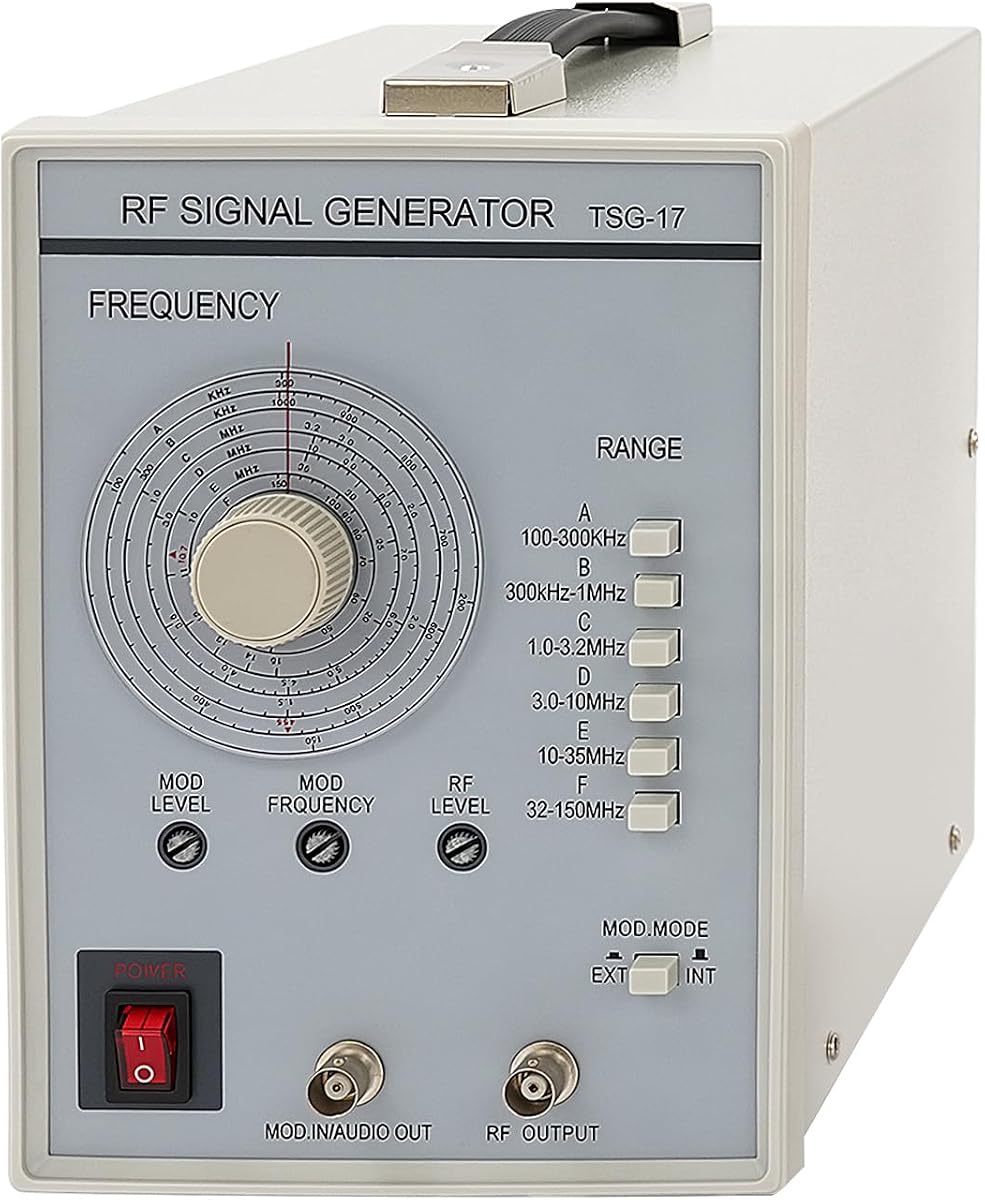
The TSG-17 High Frequency Signal Generator is designed for commercial and household use with a focus on accuracy across a 100kHz to 150MHz range. It supports harmonic outputs up to 450MHz, which can be useful for testing receiver sensitivity at higher bands.
We may earn a commission when you buy through this link, at no additional cost to you.
External modulation input allows for more complex signal simulations using an external signal source, adding a layer of flexibility for specialized testing tasks. The unit operates on standard 110V power, ensuring compatibility with typical household or office electrical systems.
However, lower ratings indicate potential issues with consistency or user experience that might affect long-term reliability. Prospective buyers should weigh the feature set against the feedback to ensure it meets their specific accuracy requirements.
This model might be appropriate for budget-conscious users needing basic RF signal injection without advanced digital interfaces. It serves as a straightforward option for fundamental radio testing and repair work.
Supports harmonics up to 450MHz, extending utility for testing receivers beyond the fundamental frequency range.
Allows connection to external sources for customized modulation patterns and advanced signal simulation tasks.
We may earn a commission when you buy through this link, at no additional cost to you.
This Adjustable Signal Generator specializes in industrial control signals like 4-20mA and 0-12V, making it ideal for PLC and sensor testing. It includes PWM output functionality, adding versatility for applications requiring frequency modulation alongside standard analog signals.
We may earn a commission when you buy through this link, at no additional cost to you.
The built-in lithium battery supports 1-5 hours of continuous use depending on the load, ensuring portability for on-site maintenance without immediate access to mains power. Short circuit protection adds a layer of safety for both the device and connected equipment during testing.
While it excels in process control scenarios, it may not meet the needs of RF or high-frequency digital circuit testing. Users should verify if their requirements align with the voltage and current ranges offered before purchase.
It is a practical choice for maintenance technicians working in automation environments where precise current and voltage signals are routine. The combination of battery operation and safety features enhances its utility for field service.
Designed specifically for 4-20mA loops and common voltage levels used in industrial automation and control systems.
Built-in battery allows for extended field use without relying on external power sources during troubleshooting.
We may earn a commission when you buy through this link, at no additional cost to you.
The Riiai 0-10V Signal Generator is tailored for precision analog testing with clear 4-digit display options for easy reading. It supports both voltage and current outputs, making it useful for calibrating instruments and testing panel interfaces in control systems.
We may earn a commission when you buy through this link, at no additional cost to you.
Programmable preset points allow users to save frequently used values for quick access, speeding up repetitive testing tasks. The compact design and rechargeable battery make it highly portable for engineers who need to move between different stations or sites.
While it offers high precision in voltage and current settings, it lacks RF signal generation capabilities entirely. Users looking for waveform or frequency modulation will need to consider other models designed for those specific functions.
This device is best for instrumentation technicians and engineers focusing on analog signal calibration and process control systems. Its safety features and ease of use make it a reliable addition to a maintenance toolkit.
4-digit readout ensures accurate setting and monitoring of signal values during critical calibration work.
Stored preset points streamline workflows by allowing instant recall of common testing values without re-entry.
We may earn a commission when you buy through this link, at no additional cost to you.
The Riiai SG003A offers a broad range of signal types including current, voltage, and pulse, making it a versatile tool for PLC testing. Its 2.4-inch TFT color screen provides real-time visual feedback, simplifying the process of monitoring output curves and settings.
We may earn a commission when you buy through this link, at no additional cost to you.
With a 3000mAh battery, it supports up to 26 hours of operation, ensuring reliability for extended testing sessions without interruption. Programmable output modes like monotonous rise and cycle allow for automated testing sequences without manual intervention.
The focus on industrial signals means it does not support RF modulation or high-frequency waveform generation. Users should align their testing requirements with the device's capabilities to ensure it meets their specific needs.
This generator is excellent for automation engineers and technicians who require a robust analog simulator for control system validation. Its long battery life and visual feedback features enhance usability in complex industrial environments.
Visualizes signal changes over time on a color screen for easier troubleshooting and verification.
Up to 26 hours of continuous operation supports full-day field work without needing frequent recharging.
We may earn a commission when you buy through this link, at no additional cost to you.
The DROK 4-20mA Generator provides a simple and straightforward solution for generating standard industrial signals. Its multifunctional design allows simultaneous output of ampere and voltage signals through a single module, reducing setup complexity for quick tests.
We may earn a commission when you buy through this link, at no additional cost to you.
Control is managed via a multi-cycle precise potentiometer, which offers tactile feedback for adjusting signal levels. While it lacks a digital display, the mechanical control is reliable and intuitive for users familiar with analog instrumentation.
This unit is particularly well-suited for LED testing and basic PLC panel adjustments where visual feedback is less critical than precise output. The compact size ensures it fits easily into pockets or toolkits for maintenance personnel.
It is recommended for users who prioritize simplicity and cost-effectiveness over advanced digital features. For standard analog signal generation, it serves as a dependable and portable solution.
Mechanical knobs provide direct tactile adjustment of signal levels without complex menus or digital inputs.
Single module integration saves space and simplifies connections for quick testing on the go.
We may earn a commission when you buy through this link, at no additional cost to you.
Choosing the right Amfm Signal Generator involves evaluating technical specifications and usability features to match your specific testing requirements. Consider the following factors to ensure you select a device that offers the necessary performance and reliability.
The frequency range determines the span of signals the generator can produce. Ensure the maximum output frequency meets or exceeds the requirements of your circuits or RF systems to avoid limitations during testing.
Select a model with a frequency ceiling that comfortably covers your target application range.
Modulation types such as AM, FM, and PM are essential for simulating real-world signals. A generator with versatile modulation options allows for comprehensive testing of communication systems and receivers.
Prioritize devices that support the specific modulation types needed for your projects.
Single or dual channels affect how many signals you can generate simultaneously. Dual channels are beneficial for testing differential circuits or comparing input and output signals without extra equipment.
Choose dual channel units if you need independent signal control for complex setups.
Signal purity refers to the absence of noise and distortion in the output. Higher resolution and sampling rates ensure cleaner signals, which are critical for precision measurements and sensitive electronic testing.
Look for high resolution and low distortion specifications for accurate results.
Portability is key if you plan to use the generator in field service or mobile labs. Built-in batteries and compact designs enhance mobility, allowing you to work without constant access to wall power.
Opt for battery-powered and lightweight models for maximum field flexibility.
A clear and intuitive interface reduces setup time and minimizes errors during operation. Digital displays with touch controls or clear buttons help visualize waveforms and adjust parameters quickly.
Select units with readable screens and logical menu structures for ease of use.
Connectivity options like USB or Bluetooth enable remote control and data logging. These features are valuable for automation and integrating the generator into larger testing systems.
Ensure the device supports connectivity protocols compatible with your software tools.
Robust construction ensures the generator can withstand frequent use and transport. Metal housings and protection features like short circuit resistance extend the lifespan of the device in demanding environments.
Choose models with sturdy materials and safety protections for long-term reliability.
Begin by connecting the generator to a stable power source or ensuring the battery is fully charged. Connect the output leads securely to your device under test using appropriate cables to prevent signal loss or interference during operation.
Power on the device and select the desired waveform type and frequency. Adjust the amplitude and modulation settings as needed to match the specifications of your test scenario. Use the display to verify the output parameters before applying the signal.
After use, turn off the generator and disconnect all cables carefully. Store the unit in a dry, temperature-controlled environment to protect internal components from moisture or dust. Regularly clean the exterior and check connectors for wear to maintain performance.
An Amfm Signal Generator is primarily used to produce precise electronic signals with amplitude and frequency modulation for testing electronic circuits and RF systems. It helps engineers and technicians validate designs, troubleshoot issues, and verify signal integrity in various applications.
Choose a frequency range that covers the maximum frequencies required by your specific tests or circuits. Consider future needs to ensure the device remains useful as your projects evolve beyond current requirements.
Digital generators offer greater precision and flexibility for complex waveforms and automation. Analog generators may be simpler to use for basic tasks, but digital units generally provide better accuracy and control for modern electronics testing.
Yes, many generators support modulation types like AM and FM which are essential for wireless communication testing. Ensure the frequency range matches the bands you intend to test for accurate results.
Look for built-in short circuit protection, reverse polarity protection, and overvoltage safeguards. These features protect both the generator and the connected equipment from accidental damage during testing.
Regular calibration and proper storage in controlled environments help maintain signal purity. Avoid exposing the device to extreme temperatures or humidity which can degrade internal components.
The top picks in this guide offer a range of capabilities from basic hobbyist tools to advanced professional models. The UNI-T UTG962E leads with balanced performance, while the OWON DGE2035 provides excellent value for budget-conscious users.
Prioritize features that match your testing needs such as frequency range, modulation types, and portability. Understanding these requirements will help you narrow down the options to a model that serves you effectively.
Always verify current specifications and availability before purchasing since product details may change over time. Checking user reviews and manufacturer updates ensures you make an informed decision based on the latest information available.